
Non-Compete Lawyer in New York

Protect Your Right to Work
Your former employer says you cannot take the new job. A non-compete agreement you signed months or years ago — possibly without fully understanding its implications — now threatens to derail your career. You are left wondering: can they actually enforce this?
In many cases, the answer is no. New York courts are skeptical of non-compete agreements and apply rigorous scrutiny before enforcing them. But the threat alone can cost you a job offer, delay your career, and cause enormous stress. At Joya Law Firm, we represent employees facing non-compete disputes across New York City. Founded by attorney Kamran Joya, our firm evaluates enforceability, negotiates releases, and defends your right to earn a living.
The Current State of Non-Compete Law in New York
Non-compete law in New York is entirely judge-made. There is no statute that governs when or how non-competes can be enforced. Courts evaluate each agreement on its own facts using standards developed through decades of case law.
The 2023 Ban That Never Happened
In 2023, the New York State Legislature passed bill S3100A/A1278B, which would have imposed a near-total ban on non-compete agreements for all workers in New York — similar to the approach taken by California and a handful of other states. Governor Kathy Hochul vetoed the bill in December 2023, citing concerns about the scope of the ban and its impact on high-earning executives.
The veto means that non-competes remain enforceable in New York — but only when they survive the strict scrutiny that New York courts apply. Legislative efforts to ban or limit non-competes continue, and the legal landscape could shift. For now, the enforceability of your non-compete depends on the specific terms of the agreement, the circumstances of your employment, and how a court would evaluate it under existing standards.
How New York Courts Evaluate Non-Competes
New York courts have consistently held that non-compete agreements are disfavored because they restrict an individual’s ability to earn a living. An employer seeking to enforce a non-compete bears the burden of proving that the restriction is reasonable and necessary.
The foundational test comes from BroadBand Capital, Inc. v. Murray and its predecessors, including Reed, Roberts Associates, Inc. v. Strauman and the Brown & Brown line of cases. Under this framework, a non-compete is enforceable only if it satisfies all of the following requirements:
- Reasonable in duration — courts typically consider restrictions of one year or less to be reasonable. Agreements lasting two years or more face increasing skepticism, and restrictions beyond three years are rarely enforced.
- Reasonable in geographic scope — the geographic restriction must be tailored to the area where you actually worked or where the employer has a legitimate competitive interest. A nationwide restriction for a regional business is unlikely to survive scrutiny.
- Reasonable in scope of restricted activity — the agreement cannot prevent you from working in your entire field or profession. It must be narrowly tailored to the specific competitive activities that threaten the employer’s legitimate interests.
- Necessary to protect a legitimate business interest — New York courts recognize a limited set of interests that justify non-competes:
- Protection of trade secrets and confidential business information
- Protection of client relationships and goodwill
- Prevention of an employee who provided unique or extraordinary services from competing
- Not unduly burdensome to the employee — the restriction cannot effectively prevent you from earning a living in your chosen profession.
- Not harmful to the public — the restriction must not deprive the public of needed services (particularly relevant in healthcare and other essential industries).
If the agreement fails on any one of these factors, it may be struck down or modified by the court.
What Makes a Non-Compete Unenforceable in New York
Many non-compete agreements signed by New York employees contain provisions that would not survive judicial scrutiny. Common grounds for unenforceability include:
Lack of Consideration
A contract requires consideration — something of value exchanged by both parties. If you signed a non-compete after you were already employed, without receiving anything new in return — no raise, no promotion, no additional benefits — New York courts may find the agreement unenforceable for lack of consideration. Continued employment alone is not sufficient consideration in New York, unlike in some other states.
Overly Broad Restrictions
Non-competes that attempt to prevent you from working in your entire industry, that impose nationwide geographic restrictions without justification, or that extend for unreasonably long periods are vulnerable to challenge. The broader the restriction, the more likely a court will find it unreasonable.
No Legitimate Business Interest
If your employer cannot demonstrate that the non-compete protects trade secrets, confidential information, or customer relationships you personally developed, the agreement lacks the foundation New York courts require. Non-competes used solely to prevent ordinary competition — rather than to protect a specific, demonstrable interest — are unenforceable.
Employee Was Terminated Without Cause
New York courts have found that enforcing a non-compete against an employee who was fired without cause can be inequitable. If your employer terminated you through no fault of your own and then seeks to prevent you from working for a competitor, that combination may render the non-compete unenforceable.
The Agreement Was Signed Under Duress or Without Understanding
If you were pressured into signing a non-compete on your first day of work with no opportunity to review it, or if the terms were buried in a larger employment document without being highlighted, you may have grounds to challenge the agreement.
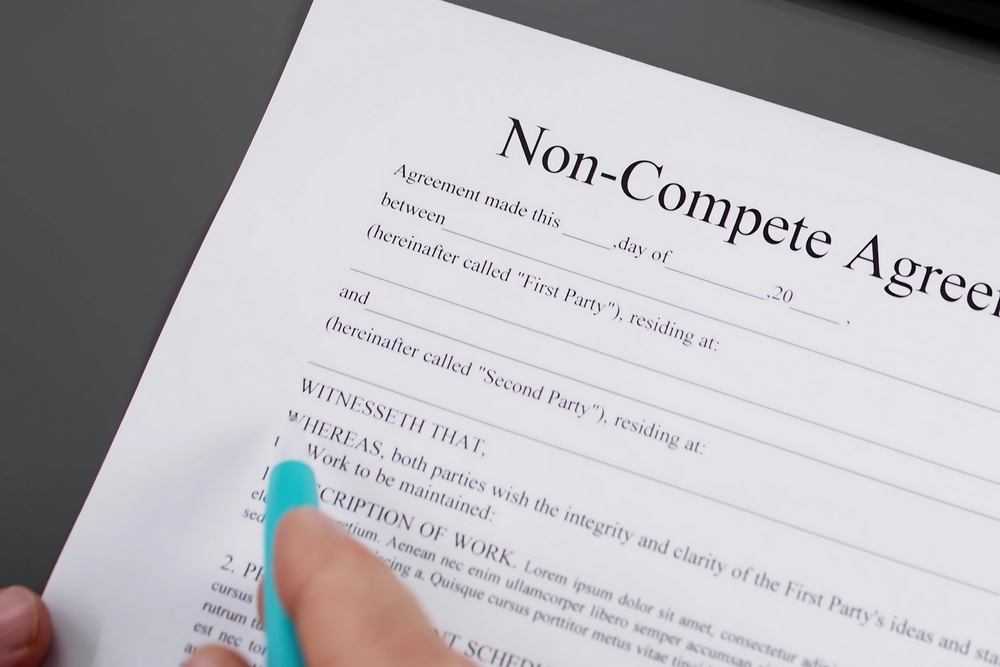
The Blue Pencil Doctrine — Courts Can Rewrite Your Non-Compete
New York courts apply what is known as the blue pencil doctrine (also called “partial enforcement” or “judicial modification”). If a court finds that a non-compete is overbroad but was entered into in good faith, the court has the discretion to narrow the agreement rather than throw it out entirely.
For example, if your non-compete restricts you from working anywhere in the United States for three years, a court might reduce it to a one-year restriction within the New York metropolitan area — if that narrower scope reasonably protects the employer’s legitimate interest.
This doctrine cuts both ways:
For employees
Even if a court does not void the non-compete entirely, it may significantly reduce the restriction, allowing you to take a new position sooner or in a broader geographic area
Against employees
An employer cannot be confident a court will void the agreement, which means litigation always carries some risk
Understanding how New York courts apply the blue pencil doctrine is critical when deciding whether to challenge a non-compete or negotiate around it.
Non-Compete vs. Non-Solicitation — A Critical Distinction
Employers often bundle non-compete clauses with other restrictive covenants. Understanding the difference matters because each type of restriction carries different enforceability standards.
Non-Compete Clause
Prevents you from working for a competitor or starting a competing business within a defined geographic area and time period. This is the most restrictive type of covenant and the most difficult for employers to enforce.
Non-Solicitation of Clients
Prevents you from soliciting or doing business with the employer’s clients or customers. Courts are generally more willing to enforce non-solicitation agreements because they are narrower — they do not prevent you from working in your field, only from targeting specific relationships.
Non-Solicitation of Employees
Prevents you from recruiting or hiring the employer’s current employees to join you at a new company. Courts typically enforce these provisions if they are reasonable in duration.
Non-Disclosure / Confidentiality Agreement
Prevents you from disclosing the employer’s trade secrets, proprietary information, or confidential business data. These are the most commonly enforced restrictive covenants and do not restrict where you can work — only what you can reveal.
In many cases, an employer’s legitimate interests can be adequately protected by a non-solicitation or non-disclosure agreement alone. If your employer insisted on a non-compete when a narrower restriction would have sufficed, that is a factor a court may weigh against enforcement.
Garden Leave Clauses — Paying You Not to Compete
A garden leave clause is a provision in which the employer agrees to continue paying your full salary and benefits during the non-compete period. In exchange, you agree not to work for a competitor while you are still technically on the payroll.
Garden leave clauses are more common in the financial services and executive employment context. New York courts view them more favorably than unpaid non-competes because the employee does not suffer the financial hardship of being unable to work. If your non-compete includes a garden leave provision, it is more likely to be enforced — but the terms still must meet the reasonableness standard.
If your non-compete does not include garden leave, that absence is a factor your attorney can use to argue against enforcement.

How to Handle a Non-Compete When Changing Jobs
If you are bound by a non-compete and considering a career move, the worst thing you can do is ignore it. The second-worst thing is to let it control your decisions without getting legal advice. Here is how a non-compete lawyer can help:
Get Your Agreement Reviewed
Bring your non-compete to an experienced employment lawyer for a detailed enforceability analysis. Many agreements contain weaknesses that are not obvious to non-lawyers.
Assess the Risk
Not every non-compete violation leads to a lawsuit. Your attorney can assess the likelihood that your former employer will actually pursue enforcement based on the industry, the competitive sensitivity of your new role, and the employer’s track record.
Negotiate a Release or Modification
In many cases, the most effective strategy is to negotiate directly with your former employer — or to request that the non-compete be addressed as part of a severance negotiation. Employers are often willing to narrow or waive restrictions in exchange for other concessions.
Defend Against Enforcement
If your former employer files for a temporary restraining order (TRO) or preliminary injunction to prevent you from starting a new position, you need immediate legal representation. These motions move fast — often within days — and the outcome frequently determines the practical resolution of the entire dispute.

Negotiating Non-Compete Removal During Severance
If you are leaving a job and your employer offers a severance agreement, this is often the best opportunity to negotiate the removal or reduction of a non-compete clause. Employers have the most incentive to cooperate when they want you to sign a release of claims.
Strategies include:
- Full removal of the non-compete clause from the severance agreement
- Reduction in duration — from two years to six months, for example
- Narrowing the geographic scope — limiting the restriction to your current market
- Carving out specific employers — allowing you to work for a named company you have already been in discussions with
- Adding a garden leave provision — requiring the employer to continue paying you during any restricted period
An experienced non-compete attorney can leverage your potential legal claims — such as wrongful termination or discrimination — to negotiate favorable terms.
When Employers Use Non-Competes to Intimidate
Not every non-compete threat is backed by a genuine intent to litigate. Some employers use non-competes as tools of intimidation — sending cease-and-desist letters to departing employees or their new employers, knowing that the threat alone may be enough to scuttle a job offer.
If your former employer is threatening enforcement, do not assume the agreement is valid or that you must comply. Many of these threats collapse under legal scrutiny. But you need an attorney to evaluate the agreement and respond on your behalf — a well-crafted response letter from legal counsel can often resolve the matter without litigation.

Why Joya Law Firm for Your Non-Compete Dispute
Non-compete disputes move fast and the stakes are your career. At Joya Law Firm, we represent employees — never employers — in non-compete and restrictive covenant matters across New York. We understand the urgency: a delay of even a few days can cost you a job offer.
When you bring your non-compete issue to us, we:
Analyze enforceability
Applying the specific standards New York courts use to evaluate each element of the agreement
Develop a strategy
Whether that means negotiating a release, responding to a cease-and-desist, or defending against injunctive relief in court
Move quickly
Non-compete disputes often involve emergency motions and tight timelines, and we are prepared to act immediately
Protect your ability to earn a living
Your right to work is fundamental, and we treat every non-compete case with the seriousness it deserves
If a non-compete is threatening your next career move, do not wait for your employer to act first. Get ahead of the situation.
Frequently Asked Questions (FAQ)
Are non-competes enforceable in New York?
Yes, but only under limited circumstances. New York courts disfavor non-competes and apply strict scrutiny. To be enforceable, a non-compete must be reasonable in duration, geographic scope, and the scope of restricted activity. It must protect a legitimate business interest — such as trade secrets or client relationships — and must not impose an undue hardship on the employee. Many non-competes fail this test.
Didn't New York ban non-competes?
No. The New York State Legislature passed a bill in 2023 (S3100A/A1278B) that would have banned most non-compete agreements, but Governor Hochul vetoed it in December 2023. Non-competes remain enforceable in New York under existing common law standards. Legislative efforts to restrict them continue, and the law may change in the future.
Can my employer enforce a non-compete if I was fired?
It is more difficult for an employer to enforce a non-compete against an employee who was terminated without cause. New York courts have found that enforcing a restrictive covenant against an involuntarily terminated employee can be inequitable, particularly when the employee did nothing wrong. However, this is not an absolute rule — the specific facts and the language of the agreement matter.
What happens if I violate my non-compete?
Your former employer may seek an injunction (a court order) to prevent you from continuing in your new role. They may also sue for monetary damages, including lost profits allegedly caused by your competition. In some cases, they may also contact your new employer, potentially putting your new position at risk. The practical consequences depend on the enforceability of the agreement and the employer’s willingness to litigate.
Is continued employment enough consideration for a non-compete in New York?
Generally, no. New York courts have held that continued employment alone does not constitute adequate consideration for a non-compete signed after the start of employment. The employer typically must provide additional consideration — such as a raise, bonus, promotion, access to confidential information, or specialized training — for the agreement to be binding.
What is the difference between a non-compete and a non-solicitation agreement?
A non-compete prevents you from working for a competitor or in a competing business. A non-solicitation agreement only prevents you from soliciting the employer’s clients or employees — it does not prevent you from working in your field. Non-solicitation agreements are narrower, less restrictive, and more frequently enforced by New York courts.
How long does a New York non-compete case take?
If your employer seeks an injunction, the initial court proceedings may occur within days or weeks. The full resolution of the case — whether through negotiation, motion practice, or trial — can take several months to over a year. Many non-compete disputes are resolved through negotiation before reaching trial, particularly when an enforceability analysis reveals weaknesses in the agreement.
Take the Next Step
A non-compete agreement should not hold your career hostage. Whether you are evaluating a new job offer, negotiating a severance package, or facing enforcement threats from a former employer, you need an attorney who understands how New York courts analyze these agreements — and who will fight to protect your right to work.
At Joya Law Firm, we represent employees exclusively. We move fast, we know the law, and we are prepared to take on your former employer.